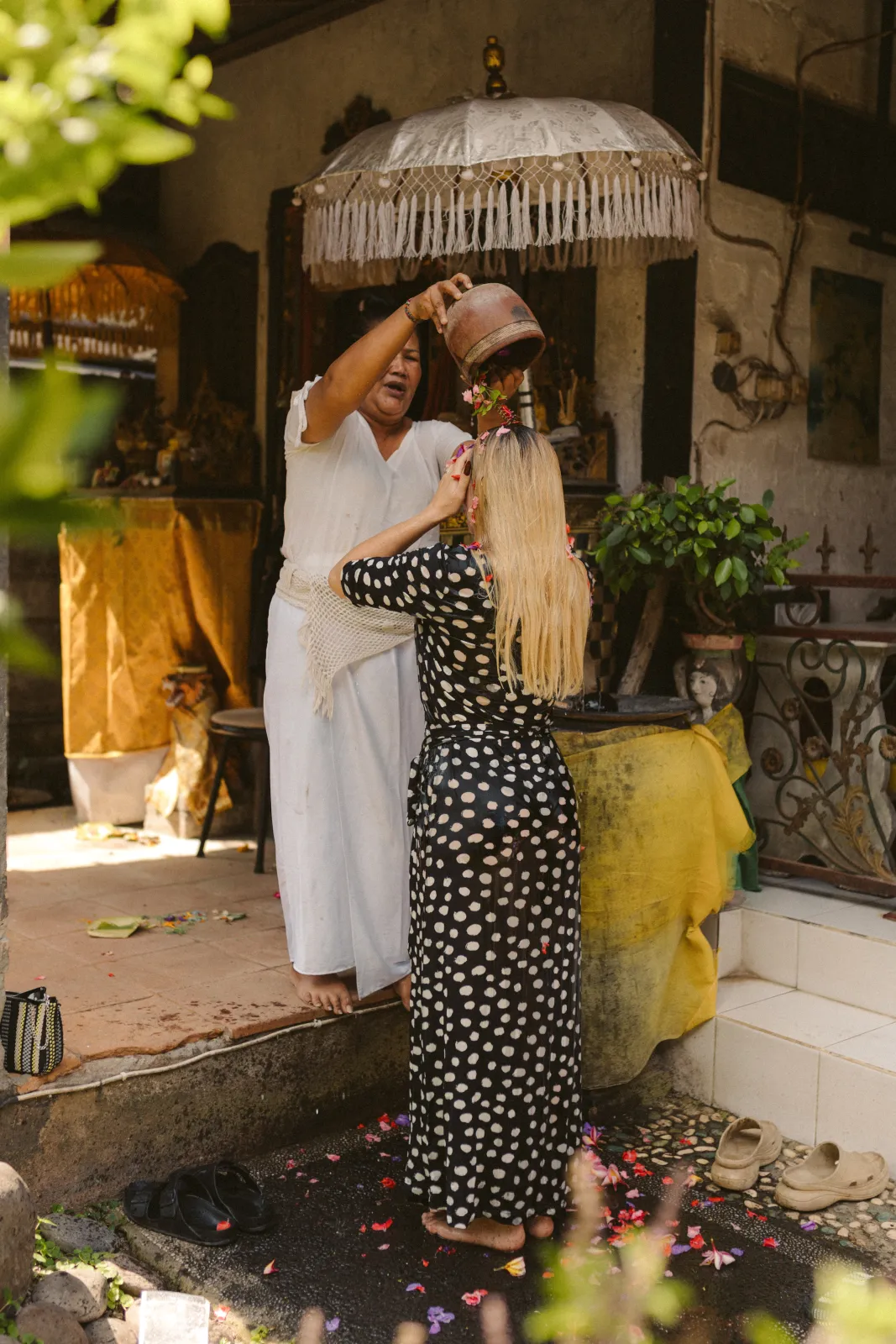
Water running over the head, flowers, incense, and white ceremonial clothing make Melukat one of Bali’s most recognisable rituals. Yet its meaning is often reduced to a beautiful purification experience for visitors.
For Balinese Hindus, Melukat is a religious ceremony of spiritual purification. The water is not simply water: during the ritual it is used as tirta — holy water connected with prayer, blessing, and the restoration of inner purity.
What does Melukat mean?
The name is connected with the Balinese word lukat, meaning to release or free. Melukat is understood as a way of cleansing what burdens a person inwardly and of returning the body, mind, speech, and actions to a more balanced state.
This does not mean that a difficult situation disappears after contact with water. The ceremony gives a person a sacred space for prayer, intention, release, and a symbolic new beginning.
Why do people go through Melukat?
Melukat may be performed at particular moments in the religious calendar, after a difficult period, during an important life transition, or simply when a person feels the need for purification. The reason, date, offerings, and form of the ceremony can differ.
It may take place at a temple or sacred spring, by the sea, at a priest’s home, or wherever suitable holy water has been prepared. For a personal ceremony, the priest or priestess determines the order of prayers and ritual actions.
How does the ceremony unfold?
Usually there is preparation, an offering, and prayer before the purification itself. The participant is then cleansed with holy water: it may be poured or sprinkled over the head and body. Flowers, incense, and mantras may also be part of the ceremony.
There is no single universal sequence for every Melukat. The place, occasion, and person leading the ceremony matter, so it is best to follow their guidance rather than repeat a sequence seen in a photograph or video.
More than a beautiful Bali experience
Melukat is sometimes presented to visitors as a wellness practice or a photogenic activity. But first of all it is a living Balinese Hindu tradition. Respect is expressed through appropriate clothing, attention to the rules of the sacred place, and a willingness to take part without turning the ceremony into a performance.
Photography is not always appropriate during every part of a ritual. It is better to ask in advance and to leave private prayers and sensitive moments outside the frame.
How is Melukat different from Mbayuh?
Melukat is a purification ritual that can be performed for many reasons. Mbayuh is a broader, individual ceremony connected with a person’s birth, offerings, and a specially selected date. Purification with water may be part of Mbayuh, but the two rituals are not the same.
Can you go through Melukat with Ibu Jero?
During a personal meeting, Ibu Jero first speaks with the person and determines what kind of work is appropriate. Melukat may become part of the meeting, but it is not an automatic or identical procedure for everyone.
I can organise the visit, help you prepare, accompany you, and translate the priestess’s explanations. You can read more on the page about a personal meeting with Ibu Jero.
Melukat is a spiritual practice within the Balinese tradition. It does not replace medical or psychological care and does not promise a particular result.
The ritual does not promise to fulfill a wish for you. The jewelry becomes a reminder of your intention, of what matters to you, and of what you want to return to.